Home /News /Exhibition /Smart Locks: Technological Advancements, Security Challenges, and Future Directions /
Smart Locks: Technological Advancements, Security Challenges, and Future Directions
2026-07-10
Smart locks have evolved from niche IoT gadgets to mainstream access control devices, reshaping home and commercial security by merging mechanical locking with digital connectivity, biometric authentication, and cloud-based management. As the global smart lock market expands—projected to exceed $7 billion by 2030—these devices are no longer just about convenience; they represent a critical intersection of physical security, cybersecurity, and user privacy. This article examines their core technologies, key benefits, persistent vulnerabilities, and emerging trends.
At their heart, smart locks integrate microcontrollers (e.g., ESP32), wireless modules, and multi-modal authentication systems. Connectivity options include Wi-Fi, Bluetooth Low Energy (BLE), NFC/RFID, and emerging standards like Matter over Thread, which enable cross-platform compatibility with Amazon Alexa, Google Home, and Apple HomeKit. Authentication methods range from traditional PIN codes and physical keys to advanced biometrics: fingerprint scanners (capacitive or optical), 3D facial recognition, and palm-vein scanning. Many modern locks combine two or more methods (multi-factor authentication, MFA) to reduce spoofing risks. For example, a lock may require a fingerprint plus a one-time password (OTP) sent to a registered smartphone.
The primary advantage of smart locks is dynamic, remote access control, a feature traditional locks cannot match. Users can unlock doors remotely via a mobile app, grant temporary access to guests, cleaners, or Airbnb hosts, and receive real-time alerts for all entry attempts. Access logs track who entered and when, creating a digital audit trail useful for rental properties, offices, and families monitoring children’s comings and goings. Integration with other smart home devices—such as security cameras, motion sensors, and alarms—creates a unified security ecosystem: cameras start recording when a door unlocks, and alarms trigger if forced entry is detected.
Despite these benefits, smart locks face significant security and privacy threats. Cybersecurity vulnerabilities are the most pressing. Weak encryption (e.g., unencrypted BLE communications), unpatched firmware, and insecure mobile apps expose locks to replay attacks, where hackers intercept and reuse valid unlock signalsUniversity.... A 2025 study by the University of Cambridge found that 60% of tested smart locks were vulnerable to BLE replay attacks, allowing attackers to unlock doors without credentialsUniversity.... Access control flaws are also common: temporary guest codes may remain valid after cancellation, and some systems let attackers extend access privileges indefinitely. Physical security is often overlooked too; many smart locks use standard mechanical components vulnerable to picking or forced entryUniversity....
Privacy risks are equally concerning. Smart locks collect and store sensitive data: biometric templates, access logs, and location information. If stored on third-party cloud servers without strong encryption, this data can leak in breaches, revealing user habits, home occupancy patterns, and biometric details. Behavioral tracking is a hidden risk: access logs create a time-stamped record of when users leave, return, or are away, which could be misused for profiling or surveillance. Even local storage is not foolproof; some cheaper models transmit biometric data to the cloud without user consent.
Power reliability and usability are additional challenges. Most smart locks run on batteries, and constant wireless communication and sensing drain power quickly. While low-power designs (e.g., deep-sleep modes) extend battery life, Wi-Fi outages or dead batteries can disable remote functions, though many locks offer mechanical key backups or USB emergency power inputs. Biometric performance varies too: fingerprint sensors may fail if fingers are wet or dirty, and facial recognition struggles in poor lighting.
To address these issues, the industry is evolving toward security-by-design and privacy-preserving technologies. Manufacturers are adopting end-to-end encryption, secure boot, and local biometric storage to reduce cloud reliance. Blockchain-based decentralized systems are being explored to enhance data integrity and eliminate single points of failure. Newer standards like Matter over Thread improve interoperability while strengthening security. Users also play a critical role: choosing certified devices, updating firmware regularly, and avoiding over-reliance on cloud connectivity can mitigate risks.
In conclusion, smart locks represent a transformative shift in access control, offering unmatched convenience and layered security through IoT connectivity and multi-modal authentication. However, their integration into digital ecosystems introduces significant cybersecurity and privacy challenges that demand ongoing innovation. As the technology matures, balancing convenience with robust security and privacy protection will be essential to realizing their full potential. For users, smart locks are not a set-it-and-forget-it solution but a tool that requires careful selection, regular maintenance, and awareness of evolving risks.
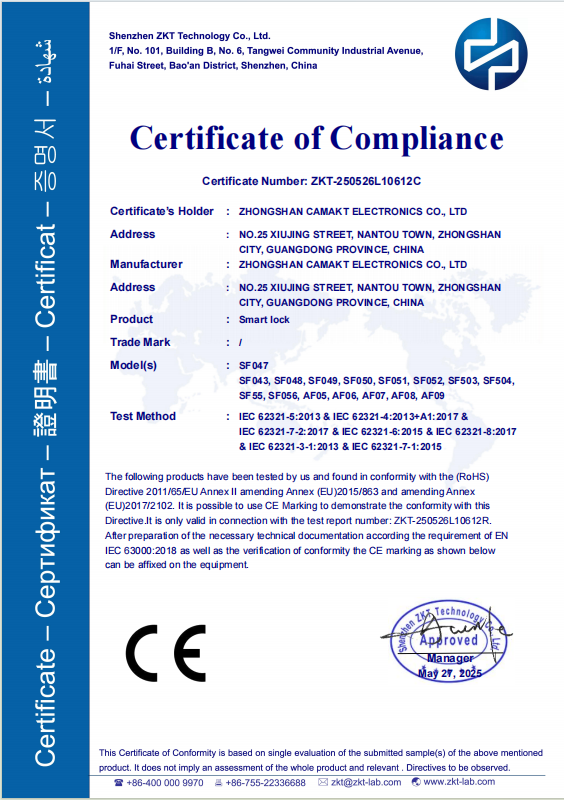
High-Quality Smart Locks Certified with EU CE RoHS Compliance for Global Safe Deployment
Smart Locks Technology Security and Future Trends
Related Article